
Par Level Inventory Guide Every Restaurant Leader Should Master

When we started working with a Midwestern multi-concept group in 2012, they had one big problem: every Sunday night, managers across their five brands would slam doors, clutch clipboards, and mutter painful invectives about inventory sheets that never matched reality. By Tuesday morning, cooks would call in “86” alerts, no chicken stock here, no cilantro there, forcing emergency runs to grocery stores at 3× cost and causing chefs to swear off parsley forever. That’s where par level inventory went from a bakery school lesson to a boardroom war cry.
In 2025, the U.S. restaurant industry is still riding a growth wave—with sales projected to hit $1.5 trillion and add roughly 200,000 new jobs, bringing total workforce to nearly 15.9 million people, highlighting both robust demand and fierce competition. NRA In cities like Austin, Nashville, Miami, Chicago, and New York, where unit growth and mid-price dining innovations are booming, margin leaks from poor inventory decisions can make or break expansion.
This article unpacks par level inventory—what it is, how to calculate it, and why multi-unit restaurant groups with high aspirations must master it.
What Is Par Level Inventory and Why It Matters
Par level inventory is the sweet spot of stock: the minimum amount of each ingredient or SKU you need on hand to confidently operate through your ordering cycle without stockouts, plus a safety buffer. It’s the beating heart of predictable operations.
In simple terms:
Par level inventory = What you need + What you keep for surprises.
If the Director of Operations wants brand consistency across Chicago, Nashville, and Miami, par levels prevent that dreaded “sold out” flash on the POS that ruins guest experience. Executive chefs know that too much stock, especially on perishables like herbs, fish, or dairy, just rots on shelves, dragging food cost percentages into the danger zone. Procurement managers use reliable par levels to forecast volumes and negotiate contracts with distributors like Sysco or US Foods. And regional managers can spot performance variances fast when theoretical inventory doesn’t match actuals.
This is also where strong back-office discipline becomes visible: inventory data only works when inputs are clean, consistent, and timely—one of the reasons many fast-growing groups rely on specialized support models, similar to those described in Outsource Data Entry Services: Boost Business Efficiency.
The Core Par Level Inventory Formula
To lock in reliable par level inventory:
Par Level = (Average Daily Usage × Lead Time in Days) + Safety StockThis formula might look math-y, but here’s the story behind each component.
Understand Average Daily Usage (ADU)
Start by figuring out how much of an item you use on a typical operating day.
Formula:
Average Daily Usage = Total Usage ÷ # DaysExample:
A Nashville fast-casual brand uses 150 lbs of lettuce over 15 days:
ADU = 150 ÷ 15 = 10 lbs/dayPro tip: Use at least 14–30 days of historical data, adjusting for promotions and seasonality. If a concept in Miami sees spikes from outdoor dining on weekends but drops during summer rains, your ADU should reflect that nuance.
Operators who want to pressure-test these assumptions often pair par analysis with cash-flow metrics like Days Inventory Outstanding (DIO) for Restaurants to ensure inventory velocity stays aligned with growth.
2. Accurately Assess Vendor Lead Time
Lead time is the number of days between placing an order and getting it on the dock.
Examples:
Local produce: ~1–2 days
Broadline distributor: ~2–4 days
Specialty imported goods: 5–10+ days
Local market realities matter: a supplier serving Austin might deliver faster than one stretched thin across suburban Tennessee. Lead-time accuracy also depends heavily on how well purchasing data flows from POS to accounting, a process that starts with selecting the right front-of-house technology, as discussed in How to Choose the Best POS System for Your Restaurant.
3. Add a Smart Safety Stock Buffer
Safety stock protects you from surprises like delivery delays or usage spikes. Think of it as insurance.
A practical rule:
Safety Stock = 10–30% of (ADU × Lead Time)
High-risk items (proteins, fresh greens, popular garnishes) usually warrant the higher end.
Restaurant Par Level Calculation In Practice
Item: Chicken Breast
ADU = 10 lbs
Lead Time = 3 days
Safety stock = 20%
Base need: 10 × 3 = 30 lbs
Safety stock: 30 × .20 = 6 lbs
Par level: 36 lbs
In other words, after delivery, you don’t want to dip below 36 lbs before your next order. At scale, many operators pressure-test these par assumptions by pairing inventory math with a Food Cost Calculator to see how small over- or under-stocking decisions ripple into food cost percentage over time.
Perishables vs Non-Perishables: Different Rules
In Chicago or New York, where rent (and pressure) is astronomical, excess perishables are cash tied up dying in a cooler. In Miami’s humidity, poorly managed perishables can go bad fast.
Perishables: lower safety stock, tighter lead times, frequent ordering
Non-perishables: higher stock allowed, less frequent ordering
Inventory precision here isn’t a luxury; it’s a necessity, and a core pillar of broader operational discipline, as outlined in Essential Tips for Streamlining Restaurant Back Office Operations and Inventory.
Par Level and the Reorder Point
Once you know your par level, reorders become automatic:
Order Quantity = Par Level − Current On-Hand InventoryNo guessing. No emotional orders. Just data-driven decisions.
Common Par Level Inventory Mistakes
Restaurant leaders often stumble when they:
Rely on gut or guesswork
Ignore lead time variability
Use static par levels despite sales changes
Apply one par level across all units
Fail to distinguish safety stock from base need
These errors lead to either costly overstock or reactive scrambling.
Inventory Technology in 2025 and Beyond
Restaurants are embracing AI and automation to make par level calculations smarter. According to recent industry analysis highlighted by Stocktake, real-time stock monitoring and predictive analytics now help forecast demand using historical sales patterns—cutting errors and waste.
Smart systems reduce food waste by helping:
Monitor movements in real time
Predict what needs reordering
Flag inconsistencies before they cost money
This isn’t theoretical—real-world implementations highlighted by Rapitek show that operators using digital inventory solutions can reduce working capital tied up in inventory by 20–30%, while cutting waste by roughly 35%.
Par Level Inventory in Multi-Unit Operations
Scaling par levels across multiple units is both art and science. Each locale—be it Austin’s lunch rush, Nashville’s weekend brunch surge, or Miami’s late-night scene—has unique patterns. The good news? With reliable data, you can standardize your approach while letting each unit’s usage data drive accurate pars.
Par Level Inventory and Industry Trends
Industry forecasts show the U.S. restaurant sector robustly expanding through 2025 and into 2026, with operators focusing on customer experience and operational excellence. NRA In this growth environment, tight inventory control and smart par levels will be key competitive advantages.
Par Level Inventory: A Survival Tool and Growth Engine
For:
Directors of Operations: par levels preserve consistency across markets
Culinary Leaders: optimize quality without waste
Purchasing Managers: lock in better contracts and forecast demand
Regional Managers: identify performance discrepancies fast
In cities where innovation and expansion are the norm—Austin’s fast-casual boom, Nashville’s testing grounds, Miami’s volume growth, and the dense classics like Chicago and New York—precise par level inventory isn’t optional; it’s foundational.
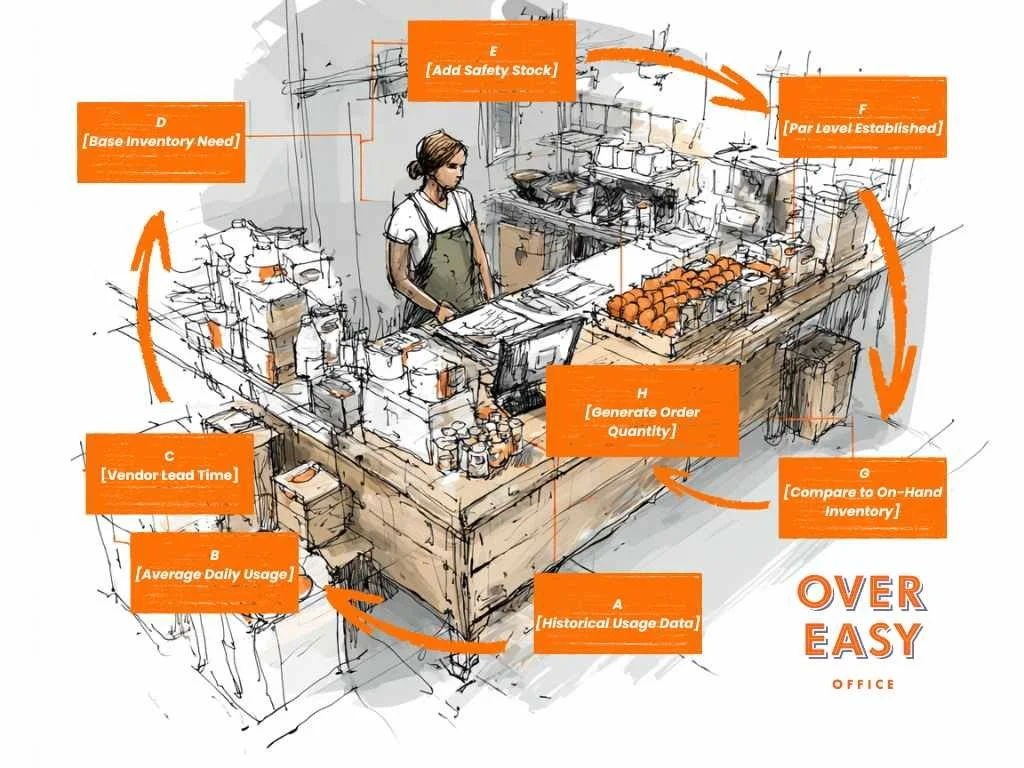
Par Level Workflow
    A[Historical Usage Data]>B[Average Daily Usage]
    B>C[Vendor Lead Time]
    C>D[Base Inventory Need]
    D>E[Add Safety Stock]
    E>F[Par Level Established]
    F>G[Compare to On-Hand Inventory]
    G>H[Generate Order Quantity]
*Restaurant par level inventory flowchart
At Over Easy Office, we’ve been refining par level inventory approaches for multi-unit restaurants for over 13 years, managing everything from unit-of-measure creation to vendor item mapping, cross-vendor inventory tracking, inventory control, invoice-to-PO reconciliation, recipe mapping, and menu item review. Whether you’re on Restaurant365, MarketMan, or any other platform, detailed par level inventory precision changes the game, letting you grow faster, waste less, and deliver the same excellent guest experience from Austin to New York.
If you want to imagine that Sunday night without chicken stock panics, the kind we’ve lived through across hundreds of restaurant groups, contact us today to add inventory management support to your operation and embark on mastering par level inventory with data, discipline, and a healthy dose of tech smarts.